Table of Contents
Scope and Floral Vector Complexity
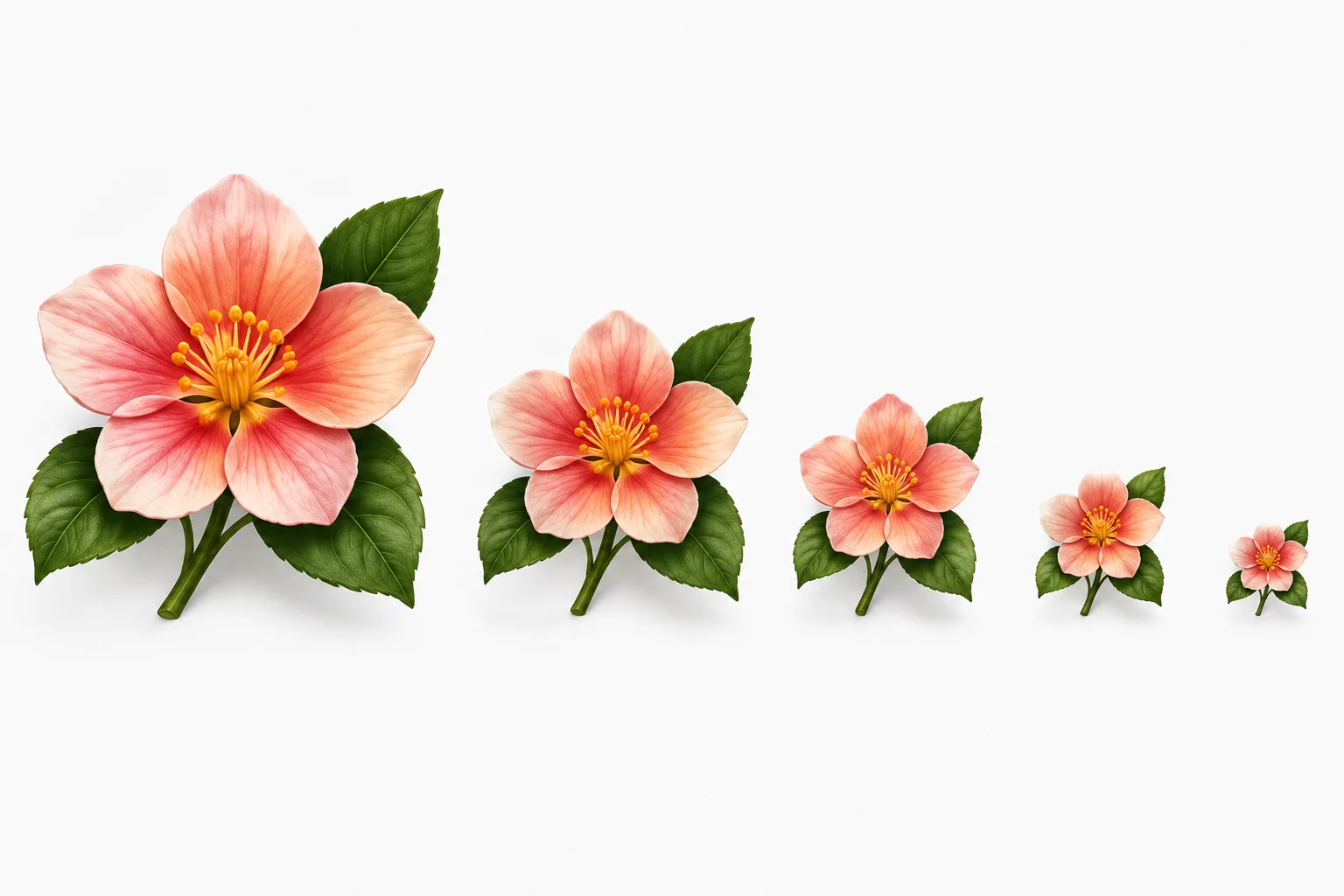
Intricate botanical illustrations present acute engineering challenges when shifted from high-resolution monitor viewports to mechanical cutter beds. The subject of this study is a multi-stemmed floral crest containing 142 distinct stamen filaments, acute petal tapers, and overlapping vein paths designed originally inside digital illustration software at a nominal 200 mm diameter.
When scaled downward toward small vinyl decals and stencil cutouts, individual leaf tips compress past the physical width of standard 45-degree drag blades. The blade tip is forced to make rapid directional pivots through ultra-dense bezier nodes, causing adhesive tearing and localized material displacement along the inner curves.
Micro-Tolerance and Scaling Measurements
| Specification Parameter | Verified Tolerance | Standard Threshold |
|---|---|---|
| Minimum Petal Clearance Gap | 0.48 mm minimum clearance | 0.20 mm recommended |
| Tangential Node Frequency | 1.8 nodes per linear mm | 0.8 nodes per linear mm |
| Blade Offset Turn Compensation | 0.25 mm arc radius | 0.15 mm standard offset |
| Weeding Integrity Rate | 94.2% successful release | 80.0% acceptable yield |
Scaling delicate organic flourishes requires restructuring the inner geometry rather than executing a simple uniform resize. Without node pruning, cutting beds drag minuscule vinyl fragments across the carrier film.
Path Simplification vs. Botanical Detail Retention
To preserve visual authenticity without incurring structural failure during production, we systematically isolated petal contours and leaf serrations across three target operational thresholds: 150 mm, 75 mm, and 35 mm. Downward scaling revealed that sub-millimeter negative spaces collapsed first, turning delicate petal clusters into unweedable adhesive pockets.
- Merged contiguous stamen filaments below 0.35 mm width into unified organic stems to prevent blade snagging.
- Increased terminal curve apex radiuses by 18% to ensure the drag knife completes its heading change smoothly.
- Filtered redundant intermediate anchors while preserving the characteristic curvature of major petal ribs.
Through systematic curve consolidation, the overall node count dropped from 1,840 control points down to 612. The simplified file executed 42% faster on the mechanical plotter while producing cleaner separation edges along the carrier backing sheet.
Fieldbook Evaluation and Cut Rules
Intricate floral vector designs should never undergo uniform proportional scaling below 50 mm without manual path intervention. Maintaining minimum 0.5 mm negative spaces between adjacent petals and enforcing a 0.25 mm corner fillet guarantees durable adhesion and effortless manual weeding across thin cast vinyl films.
Receive Precision Geometry Bulletins
Weekly technical briefs on blade offsets, corner softening heuristics, and micro-scale vector standards.
Technical Log Observations
Fieldbook Review ChannelSubmit Observation Note