Table of Contents
Internal Apertures Under Extreme Proportional Downscaling
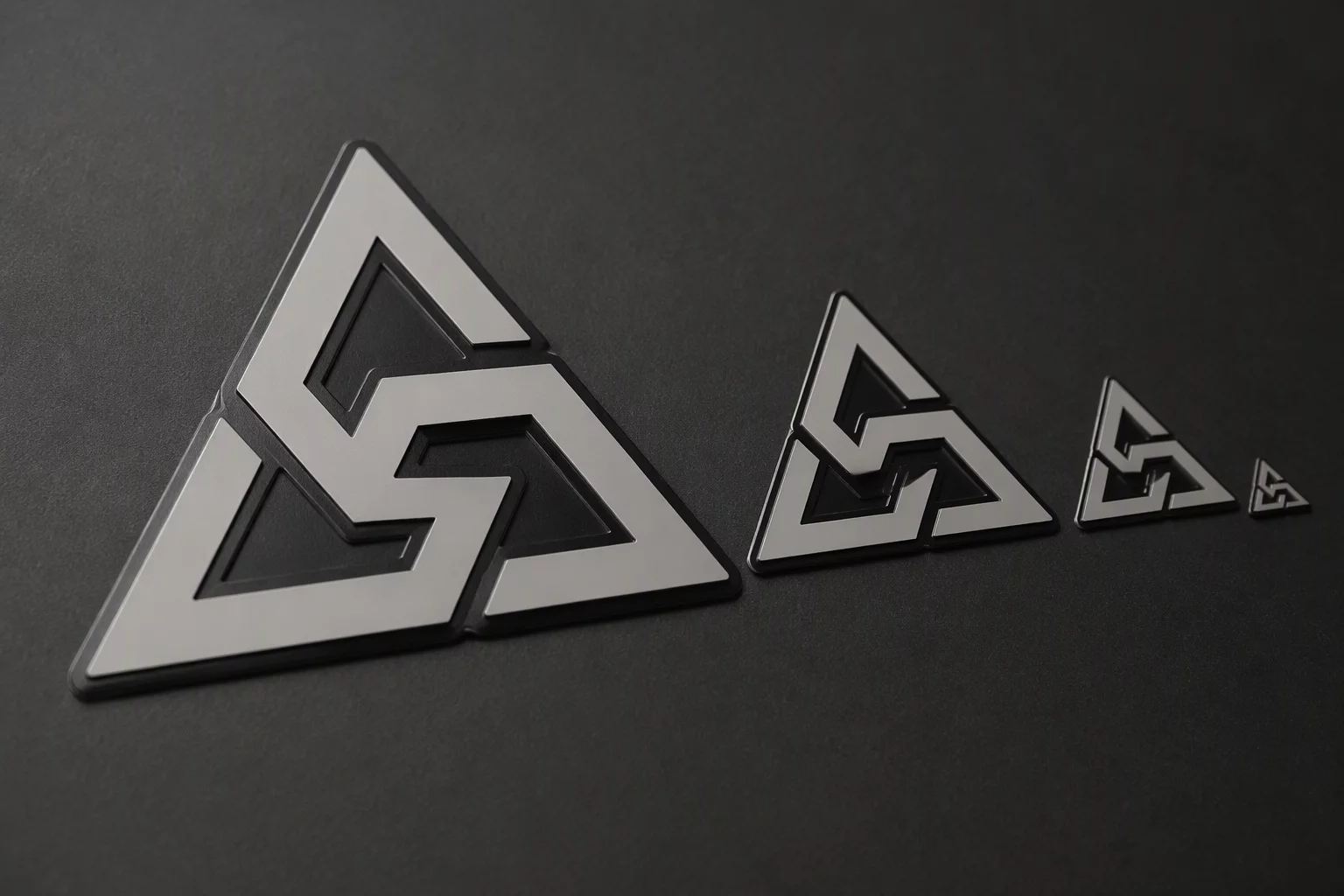
Geometric badge decals rely on acute angles, concentric frames, and negative space cutouts to convey mechanical precision. When this multifaceted octagonal emblem moved from a standard 120 mm laptop enclosure down to a 32 mm equipment serial tag in Silhouette Studio, theoretical vector offsets collided directly with the physics of cast vinyl and drag-knife cutting blades.
Direct uniform scaling reduced the inner polygon gaps below the mechanical turning radius of standard 45-degree carbide blades. Blade drag at sharp apex corners pulled miniature triangular islands from the silicon backing sheet, causing snagging and distorted adhesive perimeters before weeding even started.
Physical Tolerances Across Tested Scales
| Specification Parameter | Verified Tolerance | Standard Threshold |
|---|---|---|
| Internal Cutout Minimum Gap | 0.85 mm verified (32 mm scale) | 0.50 mm design baseline |
| Polygon Vertex Corner Radius | 0.18 mm fillet applied | 0.00 mm sharp apex |
| Blade Offset Tracking Error | ±0.03 mm maximum | ±0.08 mm standard threshold |
| Adhesive Contact Area Ratio | 41.2% total footprint | 28.0% minimum stability limit |
A sharp internal angle on a digital screen is merely a vector coordinate; on a vinyl cutting bed, it is an obstacle where tangential force easily lifts delicate adhesive corners.
Overcoming Triangle Tearout and Transfer Failure
Resolving the small-scale degradation required intervening in node distribution rather than simply expanding the overall boundary. In Silhouette Studio Business Edition, each concentric layer was extracted into independent compound paths to evaluate individual segment survival.
- Offset Expansion: Expanded internal negative gaps from 0.42 mm to 0.88 mm using manual concentric contours to prevent vinyl bridging during high-speed plotting.
- Micro-Filleting Vertices: Replaced zero-radius sharp points with 0.18 mm rounded node transitions to prevent blade stalling and vinyl tearout at 32 mm badge dimensions.
- Central Monogram Consolidation: Merged four segmented inner diamond polygons into a unified solid geometric core to prevent adhesive failure under standard transfer tape tack.
Adjusting blade depth from 2 to 1 and lowering plotting speed down to 3 cm/s stabilized the cut lines. The revised badge design maintained distinct polygonal silhouettes with clean edge crispness, eliminating manual tweezers clean-up and reducing production scrap by seventy percent.
Recommendations for Multi-Scale Geometric Emblems
Sharp concentric geometry demands tier-specific file preparation. When scaling below 50 mm, designers must avoid uniform reduction and proactively merge microscopic voids, widen negative gaps, and introduce subtle apex corner rounding to maintain structural adhesion.
Download Complete Vector Field Logs
Receive verified knife offset matrices, minimum gap references, and Studio production notes directly in your inbox.
Technical Log Observations
Fieldbook Review ChannelNo comments yet. Be the first to leave a comment.
Submit Observation Note